Email:
sales@YoViapetproducts.com
Physical address:
No.299 Chongqing Middle Rd. Qingdao, Shandong Prov., China
Email:
sales@YoViapetproducts.com
Physical address:
No.299 Chongqing Middle Rd. Qingdao, Shandong Prov., China
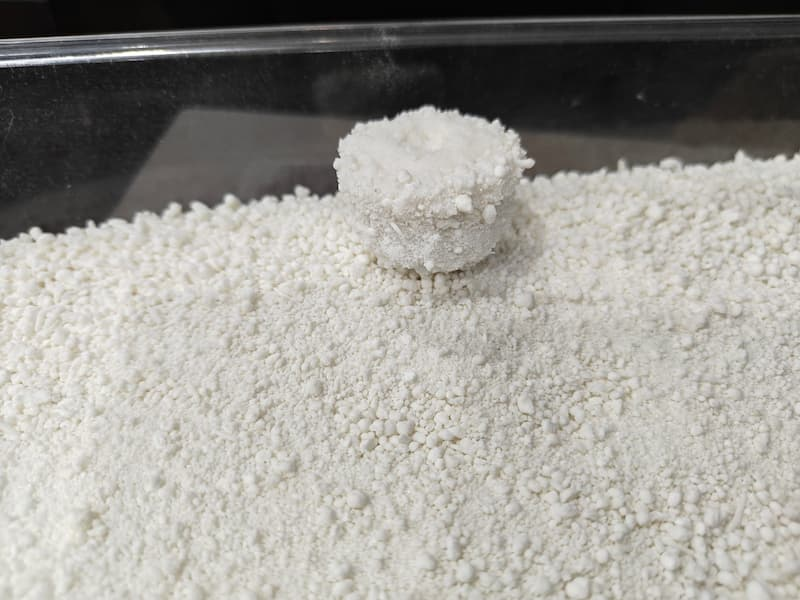
Cassava cat litter clumps through starch chemistry, not clay. How the pellets absorb, bind, lock odor, and what buyers should check before a bulk order.
Cassava cat litter has moved from a niche eco product to a serious line item on importers’ order sheets. Yet many buyers still hesitate over the same question: how can litter made from a root vegetable possibly clump like clay? The short answer is starch chemistry. The longer answer — how the pellets absorb, bind, and lock away odor — is worth understanding before you add cassava to your catalog, because it tells you which customers this product will win and which claims you can safely print on the bag.
Cassava — the same starchy root processed into tapioca — leaves behind a starch-rich residue after extraction. Litter manufacturers blend this cassava starch with plant fibers such as corn or pea residue, add a small amount of food-grade binder, and extrude the mix into cylindrical pellets that are dried to a controlled moisture level. There is no bentonite clay, no sodium-based swelling agent, and no synthetic fragrance required by the formula itself.
The result is a litter that is light in color, light in weight, and almost entirely plant-based — a growing selling point in European and North American retail, where a “plant-based” claim on the front of the bag now genuinely moves product. Our own cassava cat litter line follows this formula, and the rest of this article explains what actually happens inside the litter box.
Clumping is where cassava earns its shelf space. The process runs in four stages:
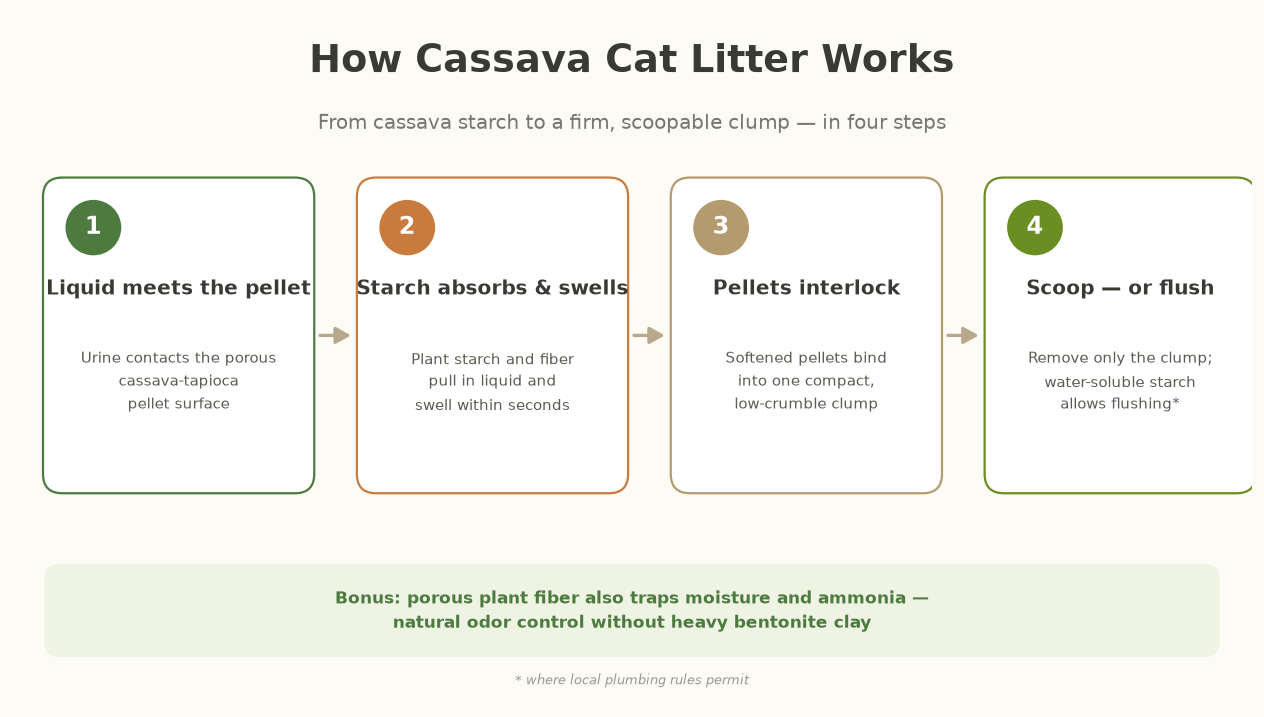
If you are used to bentonite, the difference is chemistry, not quality. Bentonite clumps because clay platelets swell ionically into a hard, heavy mass. Cassava clumps because starch gelatinizes and plant fiber interlocks. The practical consequences for your customers: cassava clumps are noticeably lighter, easier to carry to the bin, and — when the formula and pellet moisture are properly controlled — low in crumble, so less clean litter is wasted with every scoop.
Tofu litter works on the same principle, since it is also a plant-starch-and-fiber product. In side-by-side testing, well-made cassava pellets tend to hold their shape slightly better after full saturation, which is why some private label buyers position cassava as the “upgraded” plant litter on their shelves.
It is equally useful to know what failure looks like, because every symptom maps back to a production cause. Clumps that smear instead of lift usually point to a starch ratio that is too low. Pellets that dissolve into mush in the tray were dried past their target moisture or made with weak fiber. Ammonia within a day of cleaning suggests pellets that are too dense to wick liquid quickly. None of these are mysteries — they are formula and process issues that a competent factory can correct between batches. That traceability is good news for buyers: quality problems in cassava litter are fixable at the production level, which is exactly why batch COAs and sample testing matter more here than they do for clay.
Cassava controls odor by removing moisture, and moisture is what ammonia-forming bacteria need to work. Liquid is pulled deep inside the pellets and sealed into the clump, rather than sitting in the tray where it can evaporate and smell. Many formulas add a small share of activated carbon, whose porous structure adsorbs ammonia and keeps the tray neutral for longer between scoops.
Scent options — green tea, peach, lavender — are available for private label lines, but the base mechanism is physical, not fragrant. That is a useful distinction at the negotiation table: it lets you promise “odor control” as a property of the product structure, not as a perfume that fades after a week.
Odor performance also has an economics angle worth explaining to retail partners. Because a set cassava clump carries away almost no clean litter, more of each bag ends up doing its job in the tray instead of in the bin. A single-cat household typically gets through roughly a bag and a half per month, and clump-by-clump removal keeps the remaining litter fresher between full tray changes. For private label buyers, that usage pattern is a practical argument for subscription refills and multi-pack formats — a bigger basket per customer without a harder selling pitch.
In practice, cassava sits beside tofu litter at the premium end of a plant-based range. It suits markets where eco claims and low dust drive purchases — much of Europe, urban North America, and Japan — and it converts especially well with two shopper groups: households with kittens or senior cats that need softer granules, and online buyers who compare the weight printed on the bag before the price.
For a balanced shelf, we recommend the structure many of our partners use: cassava and tofu as the premium duo, a tofu–bentonite mix as the volume driver in the middle, and bentonite for the economy segment. That lineup covers every price tier without overlapping claims, and lets cassava carry the brand’s eco story at the top.
Formulas only sell if cats accept them, and cassava performs well here. The small, soft cylindrical pellets are gentle on paws — a genuine advantage for kittens and senior cats — and produce very little dust, so there is no clay cloud when the cat digs in. Tracking is modest for a plant litter, and most pellets that leave the box stay intact instead of crumbling into powder underfoot.
When switching a household from clay, advise customers to transition over seven to ten days, increasing the share of cassava in each refill. Most cats adapt without protest; the ones that hesitate usually object to a sudden change in texture, not to the litter itself.
Because cassava starch is water-soluble, used clumps break down in water. Where local plumbing rules permit, small amounts can be flushed — a daily convenience clay can never offer. The clumps are also compostable, which supports the eco story on retail shelves, and the product itself weighs far less than bentonite per volume. For importers, that weight difference shows up twice: in freight cost per container and in the weight printed on retail packaging, which increasingly influences online shoppers comparing shipping-inclusive prices.
| Cassava litter | Tofu litter | Bentonite litter | |
|---|---|---|---|
| Raw material | Cassava starch + plant fiber | Soybean residue + plant fiber | Natural clay |
| Clumping | Firm, light clumps | Soft, fast clumps | Very firm, heavy clumps |
| Dust | Very low | Very low | Low to moderate |
| Weight | Light | Light | Heavy |
| Flushable | Yes, in small amounts | Yes, in small amounts | No |
| Odor control | Good; better with carbon | Good with scent and beads | Excellent — seals ammonia in clay |
| Price position | Premium plant litter | Premium plant litter | Economy to mid |
For a deeper dive, see our full cat litter comparison. Buyers who want clay-level clumping with a plant story often land on mixed tofu–bentonite formulas instead — it depends on which segment of your market you are pricing for.
Cassava litter rewards careful sourcing. Because performance depends on pellet moisture and starch content, a weak batch shows up quickly in the tray. Before placing a bulk order, check:
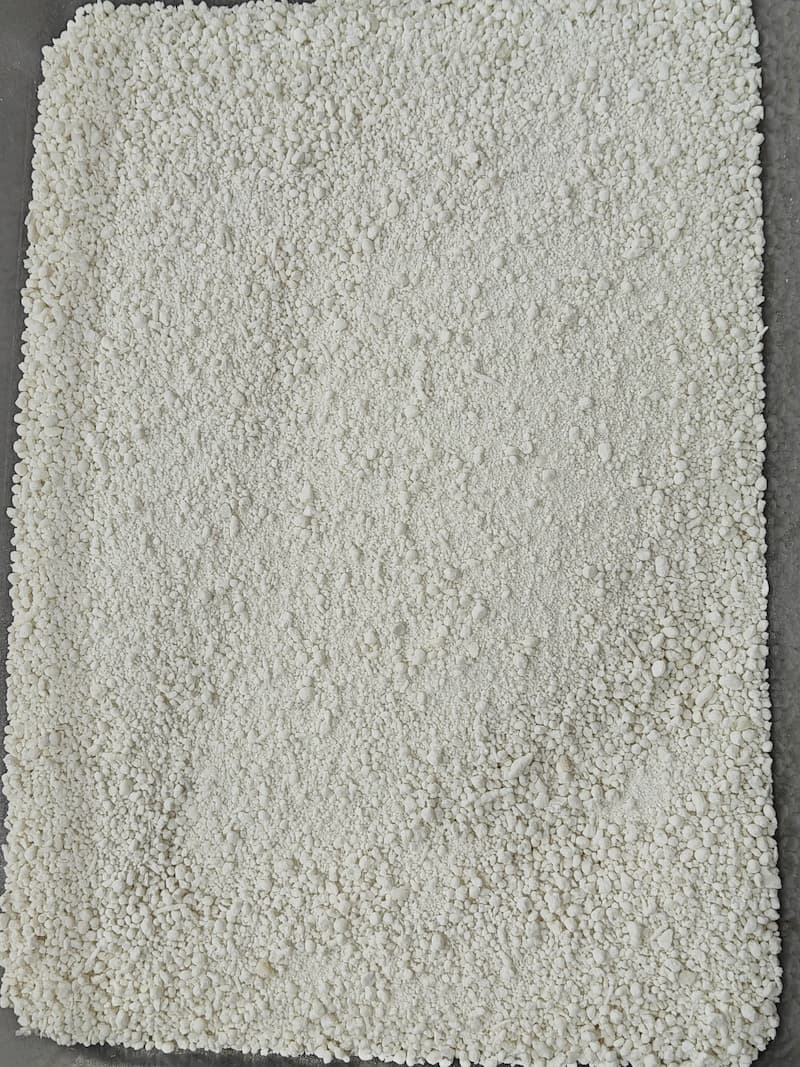
Order a sample, test it against your current bestseller in a real litter box for a full week, and only then talk volumes. A serious supplier will encourage exactly this process.
The longer answer matters more than the short one. Cassava cat litter works because starch chemistry does what clay chemistry does — absorb, swell, and bind — with a fraction of the weight and dust, plus a flushability and compostability story that clay cannot match. For importers and private label brands, it is the natural upgrade line alongside tofu litter: same plant-based positioning, slightly firmer clumping, and a clear shelf story backed by visible mechanics in the tray.
YoVia Pet Products produces cassava-based and tofu-based plant litters with private label packaging, scent customization, and 100% pre-shipment inspection. To request samples or a quotation, visit our contact page — our team replies within 24 hours.