Email:
sales@YoViapetproducts.com
Physical address:
No.299 Chongqing Middle Rd. Qingdao, Shandong Prov., China
Email:
sales@YoViapetproducts.com
Physical address:
No.299 Chongqing Middle Rd. Qingdao, Shandong Prov., China
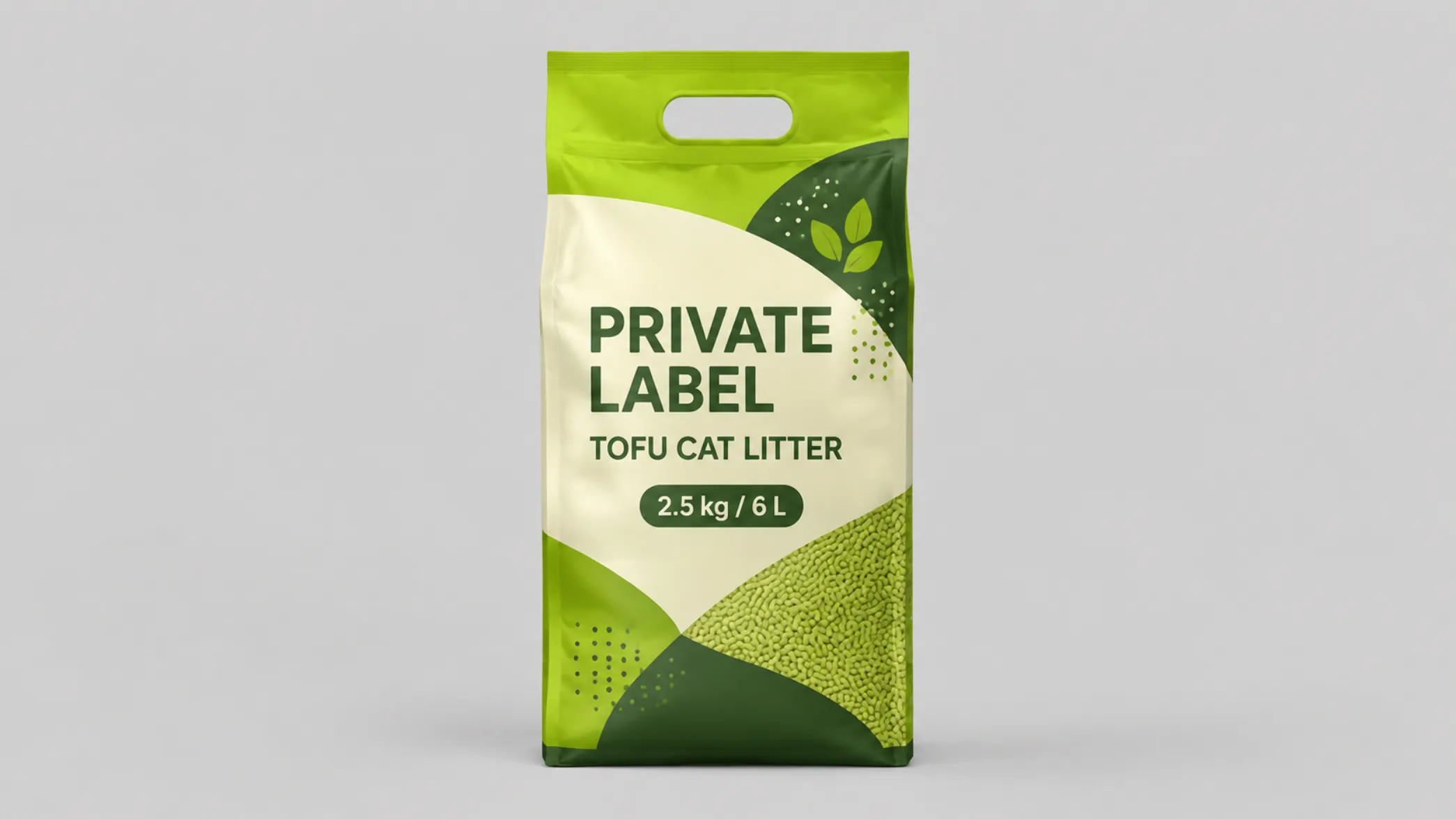
Formula, scents, specs, packaging, compliance, pricing, and launch: the complete private label tofu cat litter guide for pet brands, from a working factory.
Tofu cat litter has become the most requested format in private label inquiries — and it is not hard to see why. It is plant-based, flushable, lightweight, and easy to explain on a package. But a successful private label tofu line is not just a logo on someone else’s bag. Between formula selection and the first container, a brand makes a dozen decisions that decide whether the product earns repeat purchases or quietly dies on the shelf. This guide walks through those decisions in the order you will actually face them.
Tofu cat litter is made from plant starch and fiber — typically soybean residue from food production — extruded into soft strips or pellets that clump on contact with liquid. For shoppers, it ticks the four boxes that clay cannot: it is biodegradable, flushable in small amounts, very low in dust, and light enough to carry home without a gym membership. For brands, it carries a story that writes itself: plant-based, byproduct-upcycled, and gentle on paws.
The shopper profile matters when you position your brand. Tofu litter converts best with urban households, cat owners aged 25–45 who shop with environmental considerations in mind, and multi-cat homes that value easy scooping over rock-hard clay clumps. It commands premium pricing compared with bentonite — which is precisely why it attracts private label brands: the margin between a well-priced factory quote and a premium shelf price leaves room for packaging, marketing, and profit.
None of that is automatic, though. “Tofu litter” spans a wide range of qualities, and a weak formula shows up in the tray within days. The rest of this guide is about choosing specifications you can defend.
The sustainability angle also runs deeper than the biodegradable sticker. The raw material is a byproduct of food production — soybean residue that would otherwise be discarded — so the litter’s core story is upcycling, not just “natural.” Compare that with clay, which is strip-mined, kiln-processed, and heavy to transport: every ton of tofu litter on a shelf replaces clay that had to be dug out of the ground and shipped at far greater weight. Used clumps can be composted where facilities allow, and the product leaves no mining footprint at all. For your brand copy, this gives you a lifecycle story — byproduct to tray to garden — that clay and silica competitors cannot replicate at any price. It is also the kind of story that modern retail buyers increasingly ask you to tell in their sustainability reviews, so having it written down before the first buyer meeting is quiet preparation that pays.
Your lead formula is your first positioning decision. Private label tofu litter generally falls into four families, and each speaks to a different shopper.
| Formula family | What it is | Shopper it wins | Brand positioning |
|---|---|---|---|
| Original / unscented | Plain plant starch strips, no fragrance, no additives | Sensitive cats, kittens, minimalist buyers | Pure, safe, “nothing to hide” |
| Scented | Green tea, peach, lavender, milk, lemon, ocean breeze | Households that want the tray area to smell pleasant | Lifestyle, gifting, color-coded ranges |
| Activated carbon | Plant litter blended with charcoal granules | Multi-cat homes and odor-sensitive apartments | Performance-driven odor control |
| Mixed (tofu + bentonite) | Plant strips blended with clay for firmer clumps | Converters coming from clay who want eco benefits | Pragmatic middle ground |
Most brands lead with one hero SKU and add variants once the range is established. Here is how to think through the two most requested ones.
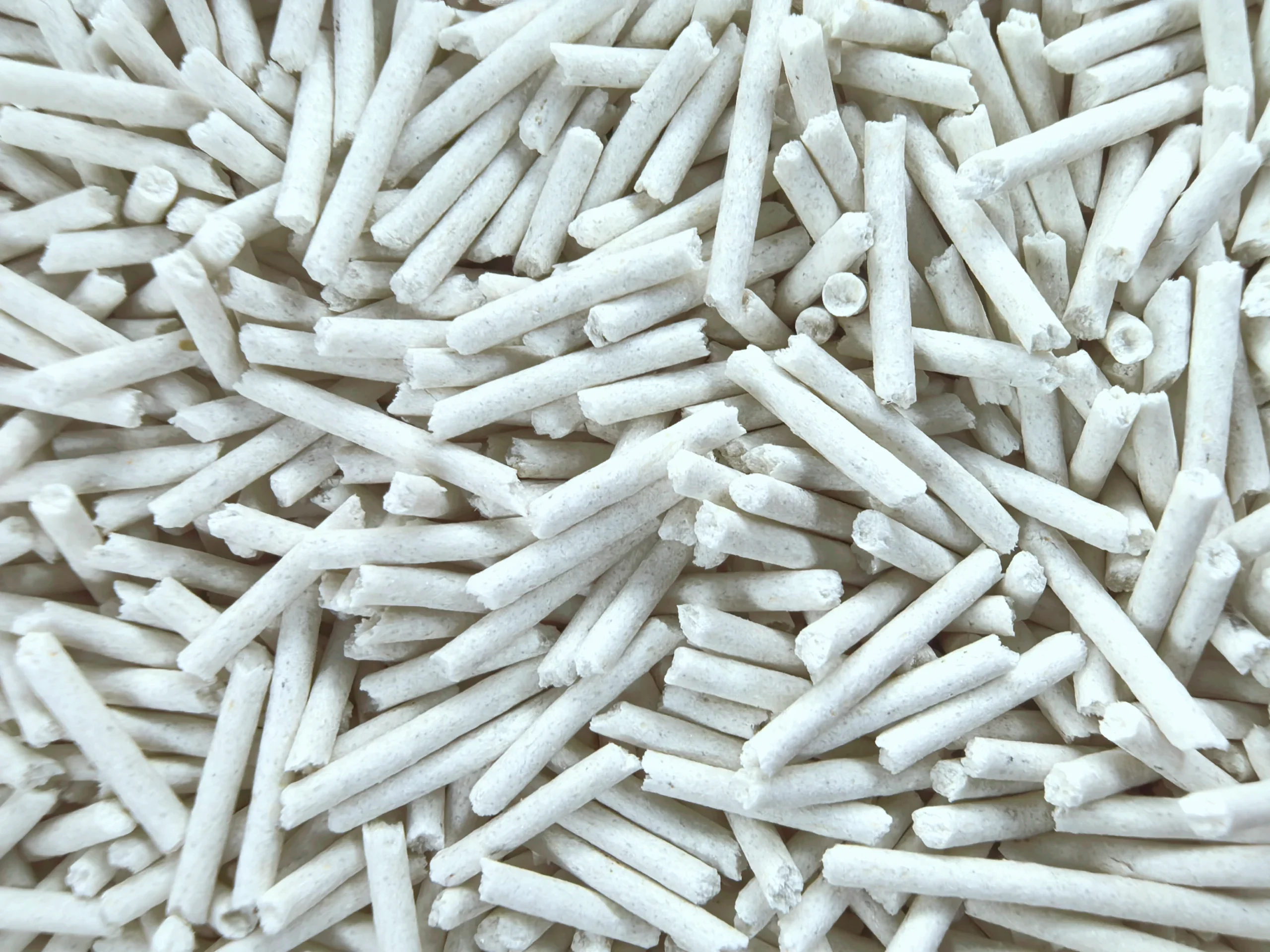
Original flavor tofu litter is the safest first SKU and, for many brands, the one that becomes the bestseller. It suits kittens and scent-sensitive cats, it avoids fragrance allergies — a real support-line topic for any brand — and it makes your package claims simple: plant-based, low dust, flushable, unscented. On the shelf, an unscented hero also signals confidence. If your brand promise is transparency and safety, lead here.
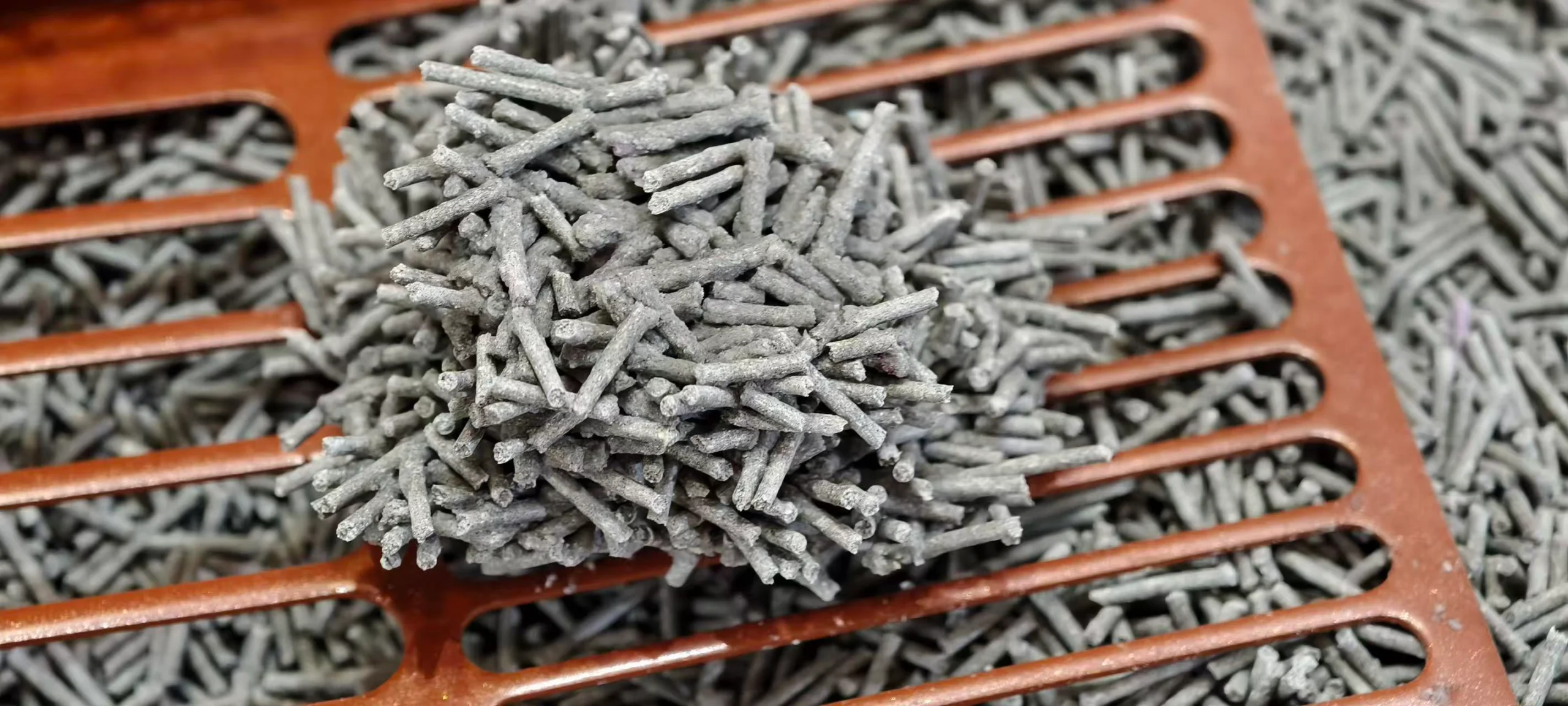
Activated carbon tofu litter blends dark charcoal granules into the plant strips. The carbon adsorbs ammonia rather than masking it, which makes this the variant for multi-cat households and small apartments — and it gives your design team a striking black-and-white contrast on the bag. It typically prices a step above original flavor, so it works well as the “pro” tier in a two- or three-tier range. One caution for your copy: carbon litters look gray to black in the tray, so set expectations on the pack shot — some first-time buyers are surprised by the color if the bag shows only white litter.
Beyond the two core formulas, scented variants and visual add-ons let a brand build a recognizable range without changing the base product.
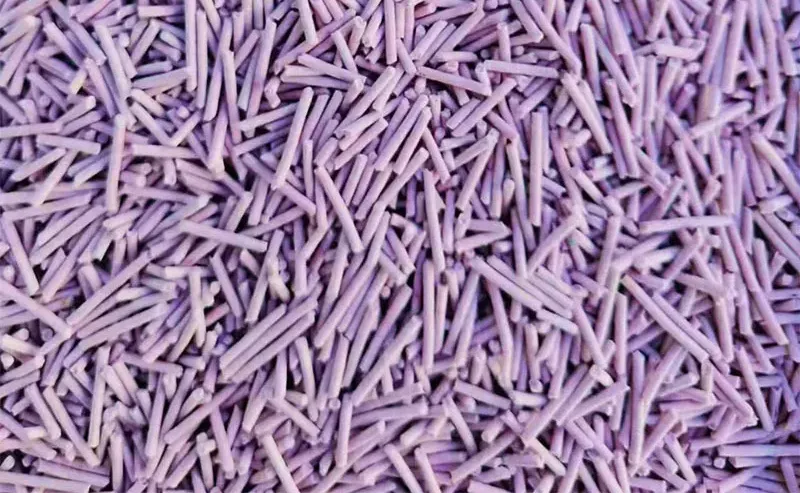
Classic scent options include green tea, peach, lavender, milk, lemon, and ocean breeze. Market preference differs more than new brands expect: European buyers skew strongly toward unscented or very light green tea, while several Asian and Middle Eastern markets welcome pronounced floral and fruit scents. Match the scent lineup to your distribution market, not to your own preference.
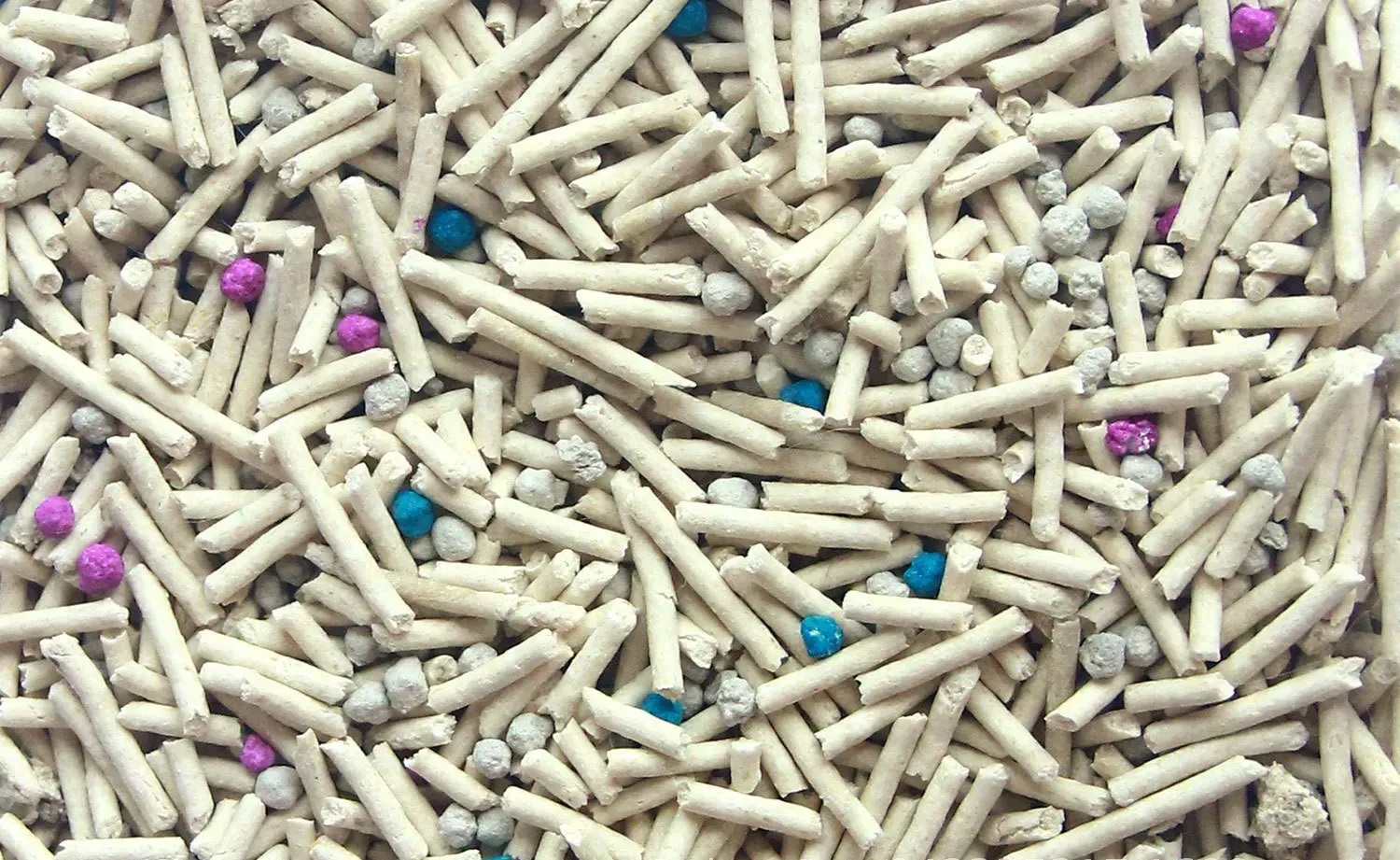
Add-ons are the second lever. Deodorizing beads boost odor performance between scoops; colored beads add shelf visibility and let you color-code variants within one bag design. They photograph beautifully, which matters more than it sounds for social commerce. Used moderately, they support a premium story; used heavily, they look like a gimmick, so ask your factory for bead-ratio options and test with real cats before committing to a design.
Private label disputes almost always trace back to a spec sheet that was never written down. Before you approve packaging, fix these parameters with your factory in writing:
| Parameter | Typical range | Why it matters |
|---|---|---|
| Granule shape | Strip (most common) or pellet | Strips clump softly; pellets resist tracking |
| Diameter | 1.5–2.0 mm | Thinner = faster clumping; thicker = firmer clump |
| Moisture content | Controlled to spec per batch (see COA) | Too wet = pellets swell in the bag; too dry = crumble |
| Clumping time | Seconds on contact | The core performance promise of the category |
| Dust | Very low by nature; verify per batch | First thing reviewers test and mention |
| Dissolution | Breaks down in water | Supports flushability and toilet-disposal claims |
Two of these deserve extra attention. Moisture content is the silent variable: it decides whether your litter survives a monsoon-season port or crumbles into fines, so require a Certificate of Analysis with every batch — not just the sample. And granule diameter is a positioning tool disguised as a technicality: 1.5 mm strips clump fast and feel soft, which suits kitten-owning households, while 2.0 mm builds a firmer clump for multi-cat homes. Some brands sell both as “soft” and “strong” tiers from the same formula.
Shoppers meet your brand on the bag long before they meet your litter. This is the stage where private label either becomes a brand or stays a commodity in disguise.
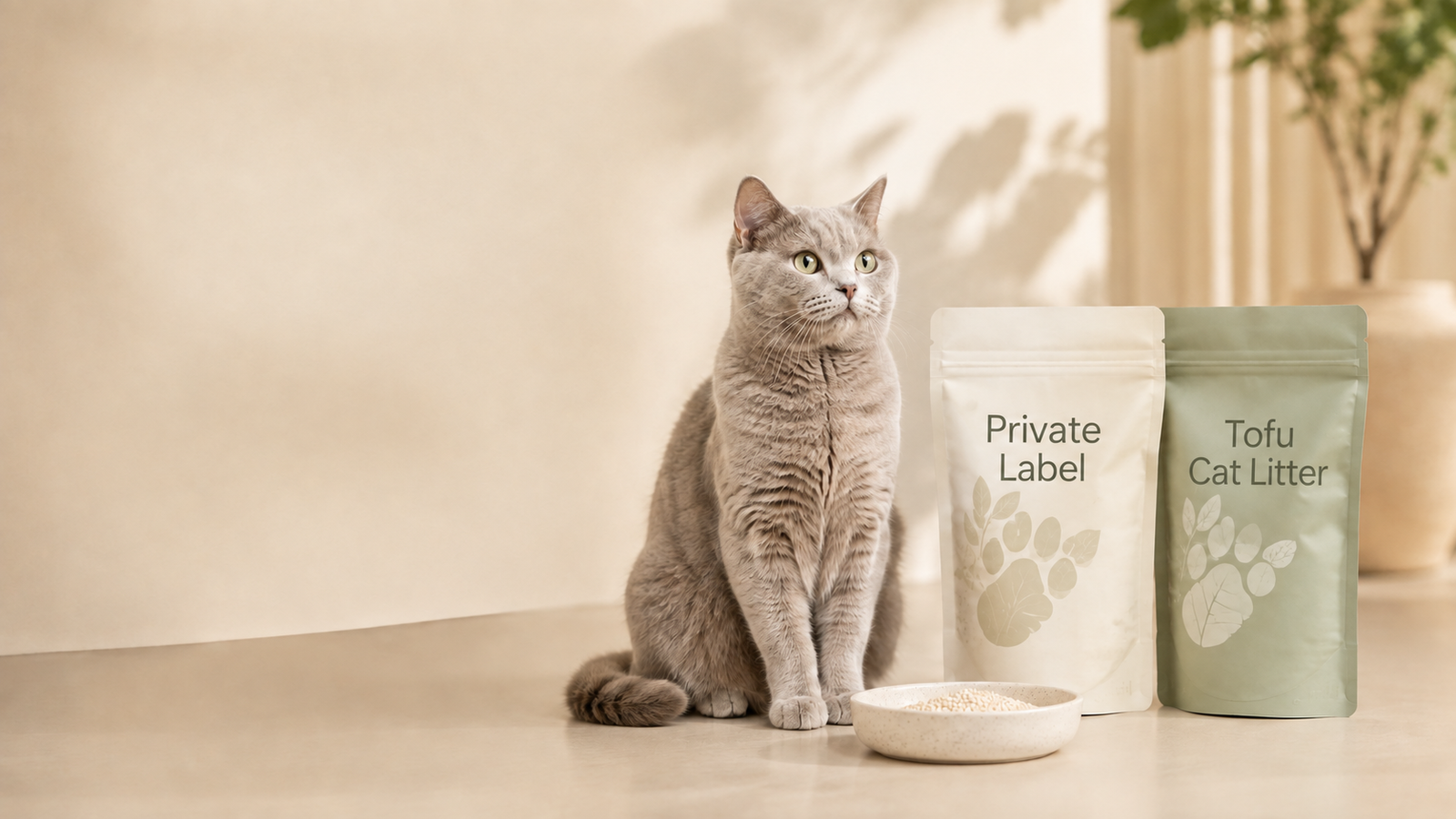
Start with format. Tofu litter ships and sells in a few standard structures, and your market’s shopping habits should decide:
Then material and print. Most private label tofu litter uses woven polypropylene or kraft-paper outer bags with a moisture-barrier inner liner — the liner is not optional for a plant-based product, because pellets reabsorb humidity. Custom printing usually has a minimum order quantity per design (confirm with your factory before commissioning artwork), so plan your first print run against realistic volume. Design-wise, the front panel should carry three things within two seconds of attention: what it is (tofu cat litter), why it is different (plant-based, flushable, low dust), and your brand name. Everything else can wait for the side panel.
A word on brand naming before you fall in love with one: the name has to clear trademark registration in your target markets, survive translation without turning comic, and fit on a dieline. Check trademark databases and domain availability before printing thousands of bags — reprints are the most expensive way to learn naming hygiene. It is also worth deciding whether your brand covers litter only or a wider pet care range; a slightly broader name saves a painful rebrand if you later add treats or accessories.
Finally, write honest claims. “Biodegradable” and “plant-based” are safe and standard. “Flushable” should always carry a local-rules qualifier — plumbing norms differ by country, and overselling it creates support tickets and returns. Your packaging is also where your barcodes, multilingual legally required text, and recycling marks live, so brief your designer with the destination market in mind.
Tofu litter is a premium category, and private label brands live or die by the price ladder they build around that fact. The practical unit to manage is price per liter, not price per bag — bags come in 6 L, 7 L, and kilogram formats that confuse shoppers until you make the comparison easy for them. A simple, defensible structure looks like this: original flavor as the hero at a mid-premium price, activated carbon roughly a tier above it as the odor-control pro option, and any scented variants slotted alongside original flavor rather than above it. That way the range reads as a coherent brand, not a random assortment.
Channel changes the math. In retail, your litter competes for a planogram slot next to established clay brands, so the pack has to justify its premium at a glance — the plant-based story, the flushability line, and the low-dust claim do that work. Online, weight becomes the story instead: tofu litter is lighter than clay, which softens shipping costs per order and lets e-commerce-first brands absorb free-shipping thresholds that clay sellers struggle with. Reviews amplify both channels — dust and tracking are the two things buyers test first and write about most, so the spec sheet you agreed on earlier is quietly a marketing document.
One more angle worth deciding early: are you a tofu specialist or a full-line brand? A specialist carries one formula family in three variants and wins on depth of story; a full-line brand adds bentonite and mixed formulas to capture every price tier, typically with tofu as the premium anchor. Both models work — what fails is drifting between them after launch.
Tofu litter travels well, but the pitch that sells it changes by region. Private label brands that adapt the range per market outperform those that ship one global SKU everywhere.
Tell your factory which market the first order is for. Formulation, scent load, and packaging recommendations change with the destination, and a factory with export experience will volunteer those adjustments unprompted.
Retail chains and distributors will ask for paperwork long before they ask for a discount. Prepare this set early and re-use it everywhere:
A factory that produces these documents without argument is telling you something about its export experience. One that hesitates is telling you something too.
Private label pricing has four moving parts, and knowing them makes negotiations faster and quotes comparable:
Lead times are typically measured in weeks: production is fast for an established formula, but custom packaging adds its own cycle, and sea freight for litter is volume-heavy even though tofu litter is lighter than clay. Plan your launch calendar backward from the container, not forward from the artwork. (A related formula note: if your market research points to clay-like clumping strength with an eco story, a tofu–bentonite mixed formula may fit better than pure tofu — it is a common second SKU for exactly that reason.)
Tofu litter is food-adjacent in its raw materials but industrial in its failure modes. Before shipment, verify:
We cover the full checklist in our guide to evaluating litter quality before a bulk order — it applies to tofu formulas directly. At YoVia, 100% of orders pass pre-shipment inspection, and we recommend buyers treat any supplier that resists pre-shipment checks as a red flag.
The brands that succeed with private label tofu litter follow a boringly similar path — which is good news, because it can be copied:
The detailed strategy version of this roadmap — brand naming, channel mix, pricing ladders — lives in our private label launch guide, and the packaging side is expanded in our piece on custom packaging and OEM orders.
What MOQ should I expect for private label tofu litter?
It depends on packaging more than formula. Stock formula in stock bags has the lowest entry point; fully custom-printed bags set the real minimum, because the print run itself carries setup costs. Ask your factory to quote both routes — many brands start with a hybrid (custom artwork on a standard bag size) and migrate to full custom at reorder.
Should my first SKU be scented or unscented?
For Europe, unscented or lightly scented green tea. For markets with stronger fragrance preferences, a scented variant can lead. When in doubt, unscented original flavor is the safest hero — it is the variant least likely to generate complaints, and it lets competitors’ weaknesses (heavy perfume, dust) stand out against you.
Is activated carbon worth a separate SKU?
Usually, yes — once the original flavor is established. It targets a distinct shopper (multi-cat, odor-first) and prices a tier higher, which builds your range’s price ladder without new packaging formats.
Can I mix tofu with bentonite for my market?
Yes, and many brands do — mixed formulas deliver firmer clumps at a mid-range price. See our formula comparison for how the families position against each other.
Private label succeeds when your factory behaves like a production partner: willing to adjust formulas, honest about batch variability, and structured around inspection. YoVia Pet Products runs tofu cat litter — original, scented, activated carbon, and mixed formulas — with private label packaging, document support, and 100% pre-shipment inspection for buyers worldwide.
If you are planning a tofu litter line, send us your market and target retail price through our contact page — we will come back within 24 hours with a formula recommendation, packaging options, and a sample plan.